

The best way from Rome Fiumicino Airport to the city depends on your final address. Choose the Leonardo Express for a direct, predictable trip to Roma Termini; the FL1 regional train when your accommodation connects better with another rail hub; an airport coach when the fare matters more than traffic risk; or an official taxi for a door-to-door transfer, especially when several travellers can share the vehicle.
Many transfer comparisons begin with the airport and stop at Termini. That misses the decision that matters: how many steps remain after you reach the first city station. A slightly slower train to the right interchange can be easier than a fast train followed by two Metro changes, while a taxi can make sense for a group arriving with heavy luggage even when it is the most expensive option for one person.
This guide covers Fiumicino Airport (FCO), also called Leonardo da Vinci Airport. It does not cover Ciampino Airport, which has different routes and fares.
Quick answer: which Fiumicino transfer should you take?
- Leonardo Express: best for Termini, nearby hotels and onward intercity trains from Rome’s main station.
- FL1 regional train: best when Trastevere, Ostiense, Tiburtina or a connecting urban rail route is more useful than Termini.
- Airport coach: best for a lower-cost direct ride to the Termini area when you can tolerate road delays and fixed departure times.
- Official taxi: best for door-to-door travel, awkward addresses, late arrivals, reduced mobility, heavy luggage or groups sharing the fare.
If your hotel is within an easy walk of Termini, the Leonardo Express is the simplest default. If it is in Trastevere or near an FL1 interchange, check the regional train first. If you are travelling as a family or group to an address inside the Aurelian Walls, compare the current official taxi fare per vehicle with the total rail or coach cost plus the final transfer.
First check: where is your accommodation?
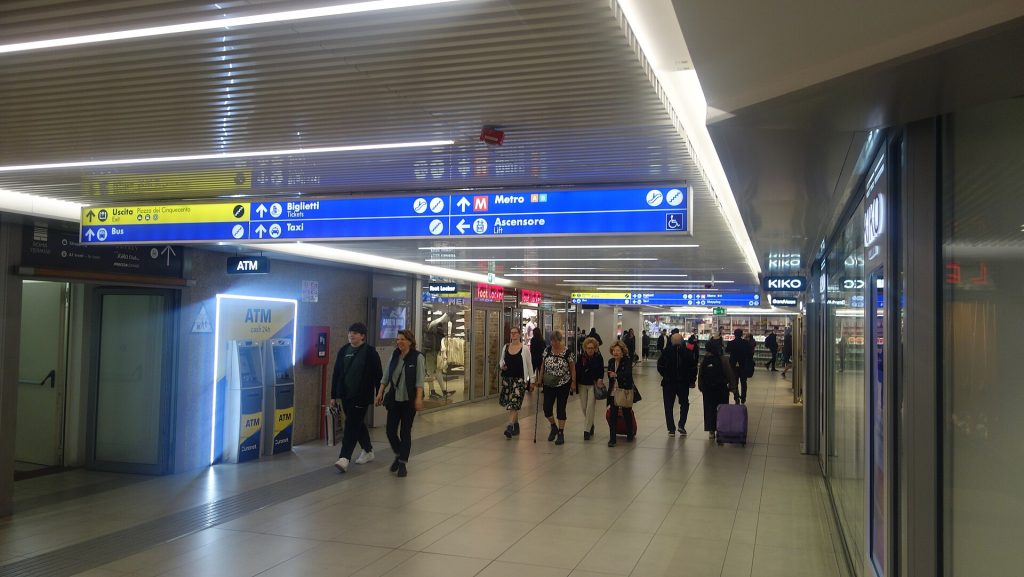
Open your accommodation address on a map before buying anything. Note the nearest useful station, not just the nearest Metro symbol. Rome’s historic centre is large, and many popular stays around Piazza Navona, the Pantheon, Campo de’ Fiori and parts of Trastevere are not beside a Metro station.
For each option, count the full journey:
- walk from arrivals to the train, coach or taxi rank;
- wait for departure;
- ride to the city;
- make any connection;
- walk from the final stop with luggage.
A direct airport train to Termini is only door-to-door convenient when Termini is genuinely useful for the last part. Conversely, a taxi’s road time varies, but it removes the transfer and luggage-handling steps.
Leonardo Express: simplest for Roma Termini
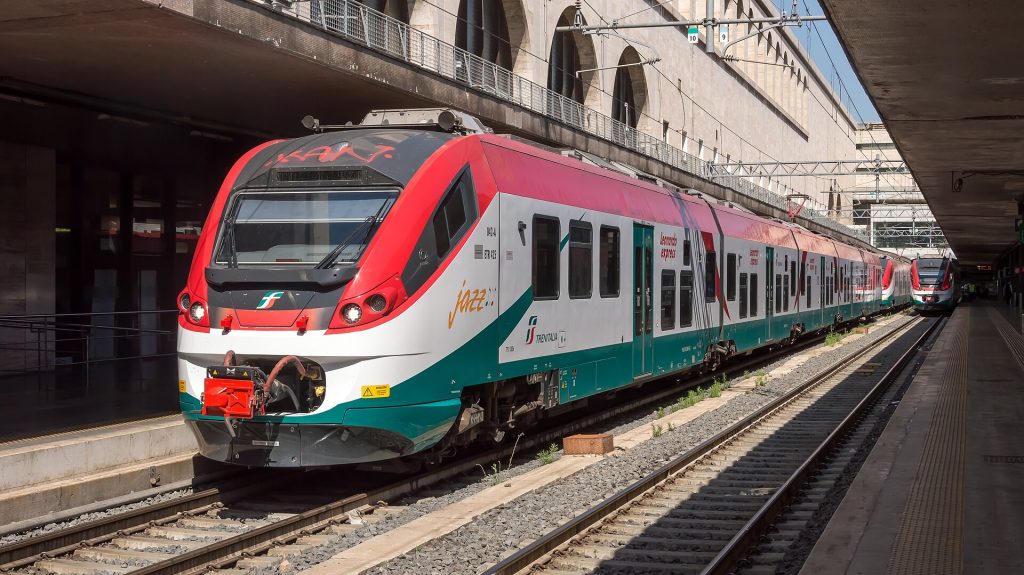
Trenitalia operates the Leonardo Express as a non-stop link between Fiumicino Airport station and Roma Termini. The operator currently advertises a 32-minute journey and frequent departures, with the airport rail station inside the airport complex. The service is designed for travellers carrying luggage, and ordinary Rome Metrebus tickets are not valid on it.
The Leonardo Express is the clearest choice when your hotel is near Termini or when you need an onward train from the main station. It avoids road congestion and does not require you to understand a chain of local stops after a flight.
The trade-off is destination rigidity. Termini may be on the wrong side of your final address. A stay in Trastevere, near Ostiense or close to another FL1 interchange can turn the non-stop service into a detour. A central hotel beyond easy walking distance may still require the Metro, a bus or a taxi from Termini.
When the Leonardo Express makes sense
- your hotel is at or close to Termini;
- you have an onward long-distance train and enough connection time;
- you value a predictable rail journey over the lowest possible fare;
- you want to avoid traffic and multiple local stops.
What to verify
Check the live Trenitalia timetable for your arrival date, especially for a very early or late flight, engineering work or strike disruption. Buy through an official Trenitalia channel or the airport station. Follow the current validation or check-in instructions for the ticket format you choose and keep the ticket available through the journey.
FL1 regional train: better for several non-Termini districts
The FL1 regional service connects Fiumicino Airport with several Rome rail hubs rather than running non-stop to Termini. Trenitalia identifies it as the alternative airport rail link and lists Roma Tiburtina among the principal connections. In practice, the route can be more useful for travellers whose accommodation or onward urban route aligns with Trastevere, Ostiense, Tuscolana or Tiburtina.
This option requires more planning than the Leonardo Express but can reduce backtracking. For example, a traveller staying in Trastevere may prefer to leave the train there instead of travelling to Termini and crossing the city again. A traveller continuing through Tiburtina may also gain a cleaner connection.
The trade-off is that the FL1 makes intermediate stops and does not serve Roma Termini as its central destination. You need to identify the correct station in advance and understand the final connection. A route that looks cheaper can become tiring if it adds stairs, platform changes and a long walk with luggage.
When the FL1 makes sense
- your accommodation is near an FL1 station or a simple connection from one;
- Termini would require you to backtrack;
- you are comfortable checking the local route before landing;
- you prefer rail but do not need the non-stop service.
What to verify
Use Trenitalia’s official journey planner for the exact date and station. Confirm that the train you select stops at your intended interchange, then check how you will complete the last segment. Do not board the Leonardo Express by mistake with a regional ticket or assume a city transport pass covers the airport train.
Airport coach: lower-cost direct travel with traffic exposure
Several licensed coach operators connect Fiumicino Airport with the Termini area. Roma Servizi per la Mobilità lists the airport shuttle companies serving the station, while each operator publishes its own timetable, ticket conditions and stop details.
A coach can be attractive for a solo traveller who wants a direct city-centre ride at a lower fare than the dedicated train. Luggage is normally stored in the vehicle hold, which removes the need to carry it through rail carriages. Online booking can also make the basic route easy to understand.
The trade-offs are road traffic, boarding queues and timetable dependence. A scheduled road journey is not as predictable as the non-stop train, and the total time includes waiting for the departure. Termini is still only the first city stop for many travellers, so add the final connection to the comparison.
When a coach makes sense
- your priority is a lower fare to the Termini area;
- you have enough time to absorb traffic or a missed departure;
- you prefer one seated road journey to navigating a rail station;
- your hotel is convenient from the operator’s exact city stop.
What to verify
Use the operator’s official site to confirm the departure terminal, bay, city stop, luggage terms, ticket flexibility and last service. A generic “Fiumicino bus” listing is not enough because operators use different schedules and conditions. Leave a generous buffer before a departing flight; the cheapest coach is poor value if traffic puts a flight at risk.
Official taxi: door-to-door convenience
Official Rome taxis wait outside the arrivals areas at Fiumicino. Roma Servizi per la Mobilità publishes the regulated airport fares and identifies the fixed-fare zone for trips between Fiumicino and addresses inside the Aurelian Walls. At the time this article was checked on 27 September 2026, the official fixed fare for that direct route was €55 per vehicle, including supplements under the published conditions.
The zone matters. “Central Rome” in a hotel description does not automatically prove that the address is inside the fixed-fare boundary. Trips outside the defined zone, trips with stops or deviations, and other destinations can follow different regulated amounts or the meter. Check the official tariff and confirm the destination before setting off.
A taxi becomes more competitive when several people share the vehicle, when luggage makes connections difficult or when the accommodation is far from a useful station. It is also the most direct option for travellers who need to minimise walking, although the exact vehicle and accessibility requirement should be arranged in advance when necessary.
The trade-off is traffic. The official mobility service gives an approximate journey time, but road conditions can change it materially. For a departure transfer, add a larger buffer than the best-case driving time.
Use the official rank
Go to the marked taxi queue outside arrivals and use a licensed white taxi with the required identification. Do not follow unsolicited offers inside the terminal. Confirm the address, applicable fare and payment method before departure, and ask for a receipt.
Private transfer: useful for specific requirements
A pre-booked car service can help when you need a named meet-and-greet, a larger vehicle, child-seat confirmation or another requirement that should be agreed before landing. It is a separate product from the official taxi rank and does not use the municipal fixed taxi fare automatically.
Request a written quote that identifies the vehicle, passenger and luggage limits, waiting policy, meeting point, cancellation terms and final price. Compare that full quote with an official taxi rather than comparing only the headline amount.
Cost and convenience comparison
| Option | Best destination fit | Main strength | Main trade-off |
|---|---|---|---|
| Leonardo Express | Termini and onward mainline trains | Non-stop, traffic-free journey | May require another transfer from Termini |
| FL1 regional train | Trastevere, Ostiense, Tiburtina and connected districts | Can avoid backtracking through Termini | More stops and route planning |
| Airport coach | Termini area | Usually the lowest-cost direct format | Traffic and schedule exposure |
| Official taxi | Specific hotel or apartment address | Door-to-door and shareable by a group | Highest solo cost and variable road time |
| Private transfer | Pre-arranged special requirements | Known meeting plan and vehicle | Variable commercial pricing and terms |
Do not compare one ticket with one vehicle fare. For a couple or group, calculate the total train or coach tickets plus any final taxi or transit leg, then compare that total with the regulated taxi fare or a written transfer quote.
Arrival scenarios
Hotel near Termini
Take the Leonardo Express unless a coach’s lower fare matters more than travel-time certainty. A taxi is mainly justified by group size, luggage or mobility needs.
Stay in Trastevere
Check the FL1 to Roma Trastevere and the final walk or connection. This often produces a more logical route than travelling through Termini. Use a taxi when the accommodation is far from the station or arrival conditions make the final segment difficult.
Historic-centre apartment away from the Metro
Compare the Leonardo Express plus a final taxi with a direct airport taxi. For several travellers, the direct taxi may remove enough handling and transfer time to justify the difference.
Onward train from Termini
The Leonardo Express is the straightforward rail connection, but build a buffer for baggage collection, walking to the airport station and finding the onward platform. Separate tickets may leave you responsible for a missed connection.
Very late arrival
Check live schedules before the flight rather than assuming the daytime pattern continues. If the last practical train or coach is uncertain, plan an official taxi or pre-booked service and verify the meeting instructions.
Departure-day rules
- Work backward from the airline’s recommended airport arrival time, not the flight departure time.
- Add time for the journey to the city station, ticketing, platform access and service disruption.
- For road transport, allow for traffic rather than relying on an average journey.
- Check Trenitalia and the coach operator on the day for engineering work, strikes or timetable changes.
- Confirm your terminal with the airline before leaving the city.
The practical choice
Take the Leonardo Express when Termini is useful, the FL1 when another rail hub matches your address, a coach when saving money outweighs traffic risk, or an official taxi when door-to-door convenience matters most. The right answer comes from the last kilometre: map the full trip to your accommodation before choosing the first vehicle out of the airport.




.jpg)